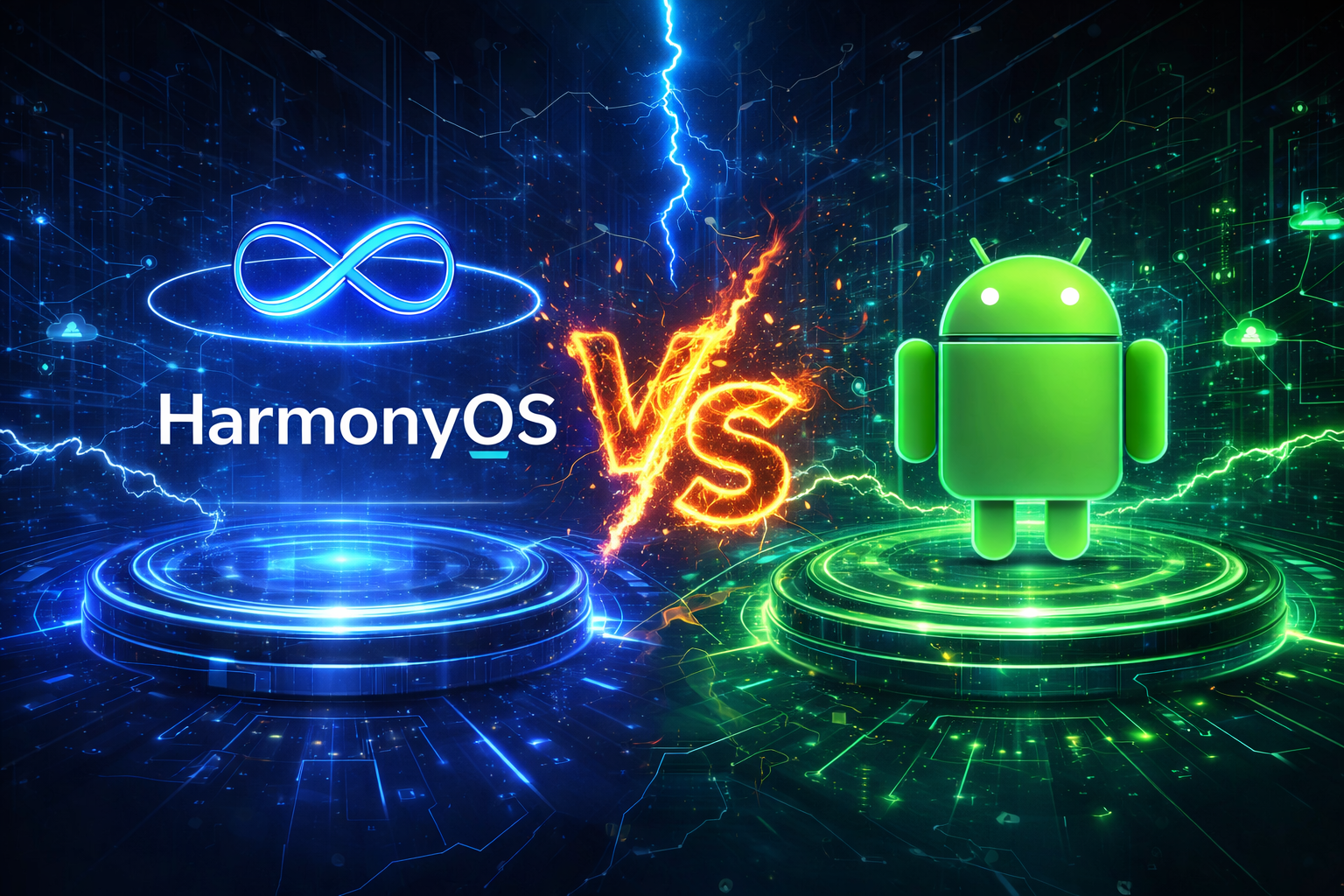
HarmonyOS vs Android: The Real Battle Isn’t Phones
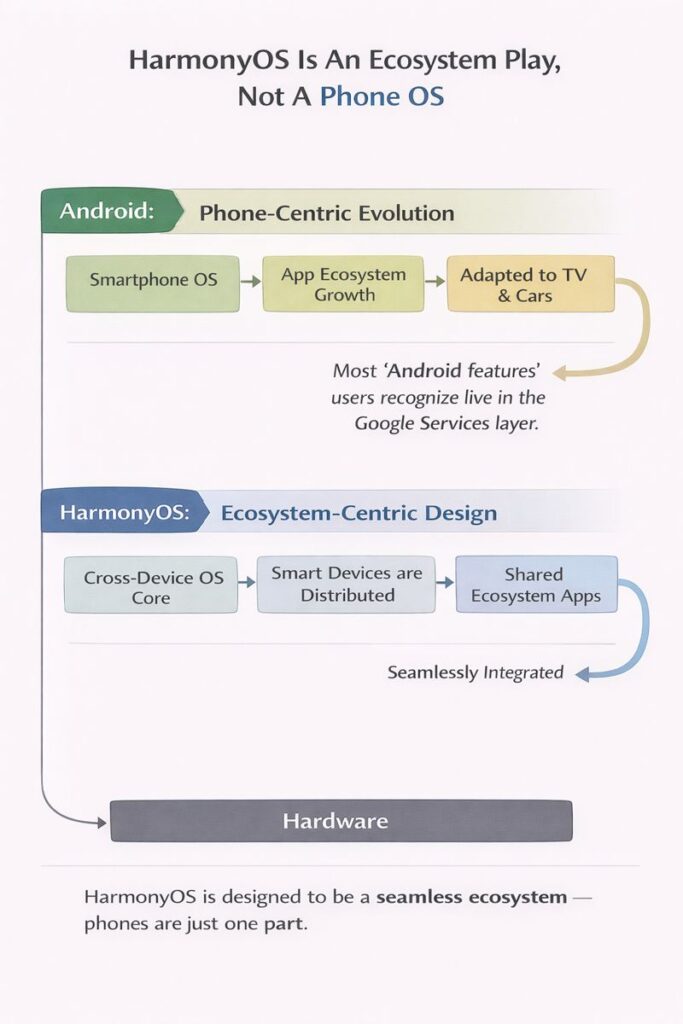
HarmonyOS Is Designed As An Ecosystem
When people compare HarmonyOS and Android, the conversation usually focuses on phones — specs, apps, and missing Google services.
But that comparison misses the bigger picture.
The real competition between HarmonyOS and Android isn’t happening on smartphones.
It’s happening across the entire ecosystem of connected devices.
Smartphones Are a Mature Market
Phones are effectively solved:
- Screens are good enough
- Performance is more than sufficient
- Battery improvements are incremental
- Annual upgrades are mostly cosmetic
That’s not where the next decade of innovation lives.
Operating systems no longer win by powering a single device well — they win by coordinating many devices seamlessly.
This is where the HarmonyOS vs Android comparison actually becomes interesting.
Android: Phone-First, Expanded Outward
Android was designed to solve one problem extremely well: smartphones.
Built on the Linux kernel and expanded through AOSP, Android scaled rapidly once Google added:
- App distribution
- Cloud services
- Developer tooling
- Monetisation infrastructure
Over time, Android was adapted for:
- TVs
- Cars (Android Automotive)
- Wearables
- Tablets
But these are extensions, not the core design.
Android’s strength is ecosystem gravity through services.
Its weakness is that coordination across devices was never foundational.
HarmonyOS: Built for Multi-Device from Day One
HarmonyOS, developed by Huawei, flips that model.
Instead of asking “How do we adapt a phone OS to other devices?”, HarmonyOS starts with:
- Multiple device types
- Shared resources
- Distributed applications
- Cross-screen interaction
In HarmonyOS, devices aren’t endpoints — they’re nodes.
A phone, tablet, TV, watch, or car display is just another interface into the same system.
This is a fundamentally different design philosophy.
Cars, Wearables, and Homes Are the Real Battleground
The fastest-growing OS opportunities aren’t in phones anymore. They’re in:
- Vehicles and in-car systems
- Health and wearable tech
- Smart homes and ambient computing
- AI-driven assistants and edge devices
These environments reward:
- Low latency
- Device cooperation
- Context awareness
- Shared identity across hardware
HarmonyOS is optimised for exactly this scenario.
Android can compete here — but it’s adapting, not leading.
Ecosystems Beat Devices Every Time
Modern OS competition isn’t about kernels or UI polish. It’s about:
- Developer ecosystems
- Service integration
- Hardware partnerships
- Long-term platform control
Android’s ecosystem is vast but tightly coupled to Google services.
HarmonyOS is smaller but vertically integrated.
Neither approach is inherently superior — but they lead to very different futures.
Understanding that difference starts with understanding Android’s real structure, covered here:
👉 Android Was Never Google — So Why HarmonyOS Matters
And the broader Linux foundation both systems rely on is explored here:
👉 What Happens When Linux Fragments Into Ecosystems?
Why Phones Are the Least Important Part of This
Ironically, smartphones may end up being the least important HarmonyOS device.
Phones are:
- User-controlled
- App-centric
- Familiar
But future devices will be:
- Ambient
- Context-aware
- AI-assisted
- Less visible
Operating systems that treat devices as cooperative parts of a whole — rather than isolated products — will have an advantage.
This is why the HarmonyOS vs Android debate matters even if you never buy a Huawei phone.
Final Thoughts
HarmonyOS vs Android isn’t a head-to-head phone fight.
It’s a philosophical split:
- Android evolved outward from phones
- HarmonyOS evolved inward toward ecosystems
Both are built on Linux.
Both rely on ecosystems more than code.
But only one was designed for a world where computing fades into the background.
That’s the real battle — and it’s only just beginning.
Further Reading
If you want to explore this topic more deeply from different perspectives:
- Linux Foundation — open-source operating system fundamentals
- Android Open Source Project (AOSP) — how Android is structured beneath Google services
- Huawei Developer Documentation — HarmonyOS architecture and distributed design