AI in Space Exploration: How Artificial Intelligence Is Shaping the Final Frontier
Introduction – Why AI Matters in the New Space Age
Artificial Intelligence (AI) is no longer a futuristic concept — it has become one of the most powerful tools propelling modern space exploration forward. As missions grow more complex and data volumes expand beyond human processing limits, AI systems now handle everything from rover navigation to satellite coordination and deep-space data analysis.
What fascinates me most about this shift is how quickly AI has gone from experimental technology to a core operational necessity. Space agencies and private companies alike depend on machine learning models and autonomous systems to overcome communication delays, unpredictable environments, and the staggering scale of information gathered from orbit and beyond.
Simply put: AI is becoming the brain behind humanity’s push into the cosmos.

This guide brings together what’s already happening today — and what’s coming next — showing how AI is reshaping space missions, exploration robotics, telescopes, imaging systems, and even plans for long-term off-world habitats.
How AI Is Used in Space Missions Today
Most people imagine space exploration as astronauts piloting spacecraft or driving rovers by joystick. In reality, much of the work is now done by AI operating far from Earth without human guidance.
Satellite Operations and Collision Avoidance
Thousands of satellites orbit Earth, with more launching every year. Coordinating them safely is impossible using manual systems alone. AI algorithms now:
- Monitor orbital trajectories
- Detect collision risks between spacecraft or debris
- Automatically adjust satellite flight paths when danger is detected
This real-time automation protects vital communication, weather monitoring, and GPS networks.
Data Processing & Analysis
Space telescopes, probes, and satellites generate terabytes of data daily — far too much for human analysis alone.
AI models analyze this information by:
- Detecting anomalies in star surveys
- Mapping known and potential exoplanets
- Identifying transient cosmic events like fast radio bursts or supernova detections
This process accelerates breakthroughs and allows scientists to focus on theoretical interpretation rather than raw number crunching.
You can explore this further in our in-depth guide on AI and space telescope data processing.
Autonomous Navigation in Deep Space
Communication delays grow to minutes or even hours once spacecraft leave Earth orbit. In these environments, crafts must operate without human input.
AI enables spacecraft to:
- Plot safe autonomous routes
- React to hazards mid-flight
- Correct trajectories without waiting for commands from Earth
This same technology powers modern Mars rover operations.
Robotic Exploration on Planetary Surfaces
NASA’s Mars rovers have demonstrated AI’s effectiveness under real-world extreme conditions. Systems like the AEGIS (Autonomous Exploration for Gathering Increased Science) platform allow rovers to:
- Identify promising geological samples
- Navigate terrain safely
- Prioritize scientific targets independently
AI dramatically increases mission productivity without raising crew risk.
Learn how this technology is evolving in our feature on Robotics in Space Exploration.
Human Exploration, Mars & Lunar Habitats
While AI excels in robotics, it is also becoming essential for human missions beyond Earth.
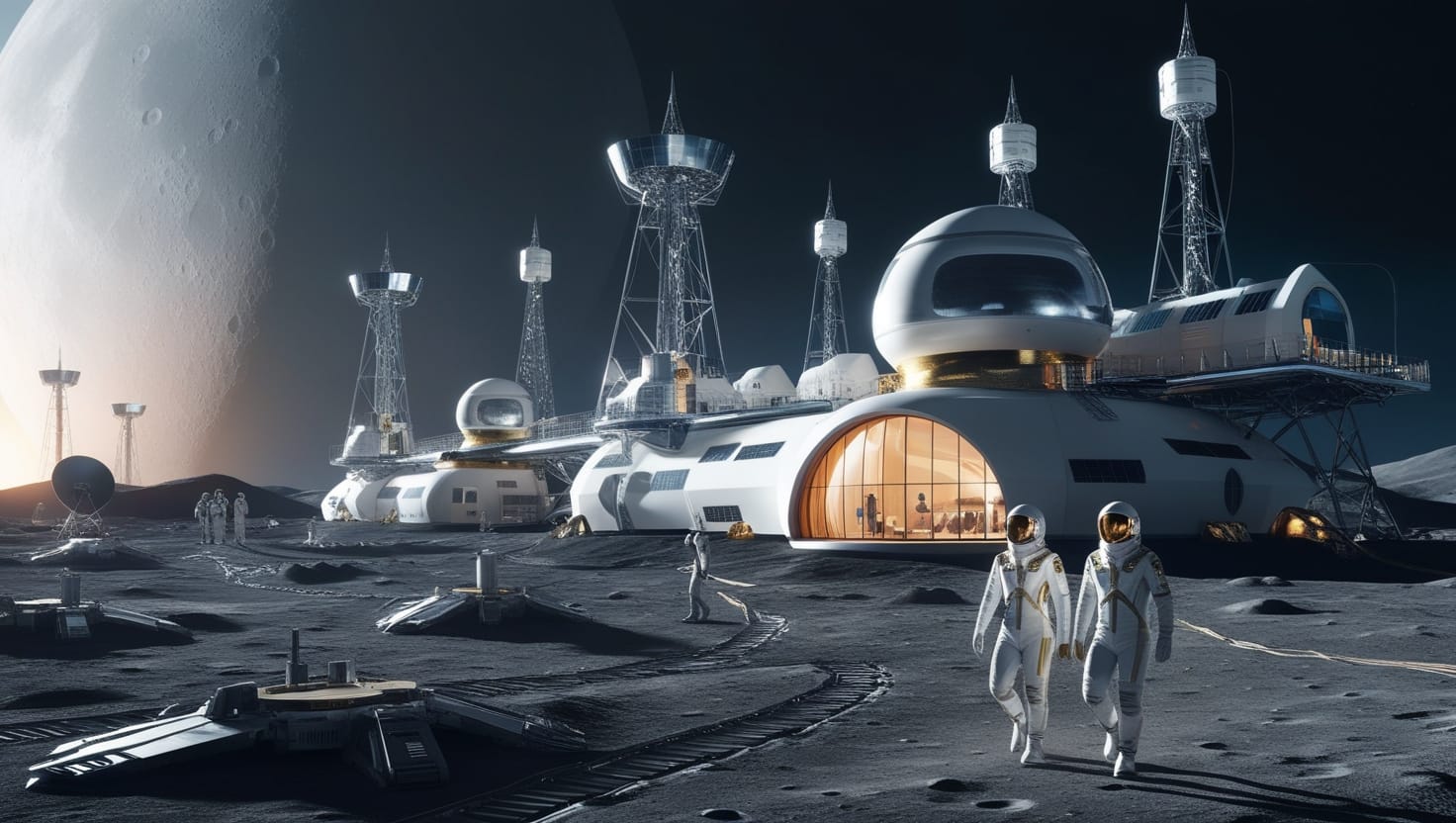
Future permanent bases on the Moon or Mars will depend on machine intelligence to maintain:
- Environmental stability
- Energy management systems
- Structural monitoring
- Agricultural systems
Machine learning platforms could track micro-fractures, regulate oxygen production, and optimize closed-loop ecosystems long before crews arrive — and long after they leave.
More on this in our breakdown of Exploring the Moon and Mars: Building Humanity’s Off-World Future.
Commercial Space Stations & Private Habitats
As government agencies partner with or give way to private companies, AI now plays a major economic role in orbit.
Upcoming commercial space stations leverage automation for:
- Docking logistics
- Habitat climate control
- Energy optimization
- Crew safety monitoring
Instead of large human control teams, smaller ground crews coordinate AI systems that run daily operations autonomously.
Dive deeper in our article on Private Space Stations & AI-Managed Orbital Infrastructure.
AI in Space Imaging & Photography
Space photography has transformed dramatically thanks to AI.
Modern imaging systems use machine learning to:
- Remove atmospheric noise
- Enhance resolution beyond hardware constraints
- Correct light distortion
- Stitch combined images into ultra-high-definition mosaics
These techniques allow unprecedented views of galaxies, nebulae, black holes, and planetary systems.
Explore current hardware and techniques in Space Photography Technology & Image Enhancement.
Satellite Imaging & Earth Observation
Beyond deep space, AI is revolutionizing how satellites observe Earth.
AI powers:
- Climate change monitoring
- Disaster early-warning systems
- Crop yield analysis
- Urban development mapping
Machine vision instantly processes raw orbital images to detect changes that humans might not spot for weeks.
Learn how this growing industry works in our overview of Satellite Imaging & Analytics Tools.
Limitations & Challenges of Using AI in Space
Despite its promise, AI faces serious operational restraints in space environments:
Radiation Exposure
Cosmic radiation can interfere with onboard processors, forcing agencies to develop fault-tolerant hardware and software redundancy models.
Computing Resource Limits
Unlike terrestrial data centers, spacecraft rely on low-power computers. Engineers must build highly efficient AI models capable of real-time cognition while operating on limited energy budgets.
Ethical Considerations
As AI systems gain autonomy, questions emerge:
- Who bears responsibility for a fatal decision?
- How much control should AI hold over life-support systems?
- Could AI-driven militarization violate space treaties?
These debates remain unsolved and highly active within policy circles.
What’s Coming Next: The Future of AI in Space
The next decade promises acceleration across multiple frontiers:
Autonomous Colonies
AI-managed ecosystems capable of supporting humans off-Earth — from atmospheric stabilization to agricultural production.
Swarm Robotics
Teams of low-cost robots working collaboratively to:
- Construct habitats
- Perform orbital repairs
- Scout hostile terrain
AI Discovery Engines
Machine-learning systems identifying celestial objects faster than all human astronomers combined — reshaping theories of cosmology and extraterrestrial life.
Global Research Integration
AI may become the infrastructure connecting international space agencies, allowing cooperative mission planning at unprecedented scales.
Why AI Will Define the Next Space Age
AI has already crossed the line from science fiction into standard mission infrastructure.
From autonomous rovers roaming Mars to machine intelligence optimizing Earth satellites and telescopes, AI stands at the core of humanity’s future beyond our planet.
And this is just the beginning.
As models grow smarter and hardware grows more resilient, AI will enable:
✅ Human settlements beyond Earth
✅ Discovery of unknown star systems
✅ Continual deep-cosmos exploration without crew risk
There is little doubt:
Where humans go in space — AI goes first.