Exploring the Moon and Mars: Building a Future Beyond Earth
The Evolution of Space Travel Technologies
The story of space exploration is one of relentless innovation. From the Apollo missions that first carried humans to the Moon to today’s plans for crewed Mars bases, every generation of technology has pushed the limits of what humanity can achieve beyond Earth.
The Apollo program of the 1960s laid the foundation for modern spaceflight. It introduced powerful launch systems, precise navigation, and life support technologies that remain the basis for spacecraft engineering today. What began as a race to the Moon evolved into a cooperative, data-driven mission to explore — and one day inhabit — new worlds.
Reusable Rockets and Private Innovation
The biggest leap since Apollo has come from reusable rocket technology.
Companies like SpaceX and Blue Origin have proven that boosters can land, refuel, and fly again — drastically cutting costs and increasing launch frequency.
SpaceX’s Falcon 9 and Falcon Heavy rockets have completed hundreds of successful landings, and their upcoming Starship system aims to carry humans to Mars.
💫 Related reading: Exploring the Universe: How AI and Robotics Are Revolutionizing Space Exploration
This new model of private-public collaboration is what’s making the dream of lunar and Martian exploration financially sustainable.
Advanced Propulsion Systems
Traditional chemical engines are powerful but limited.
To reach Mars and beyond, engineers are turning to ion propulsion and nuclear thermal drives — engines that use charged particles or nuclear heat to provide continuous, efficient thrust.
NASA’s Solar Electric Propulsion (SEP) system is already in testing for deep-space cargo and station-keeping missions.
💫 See also: AI Mission Control: How Intelligent Systems Navigate the Stars
These systems will make long-duration missions safer and faster, reducing travel time to the Moon and Mars.
Space Stations and Modular Gateways
The International Space Station (ISS) has been our orbital testbed for decades — teaching scientists how to live and work in microgravity.
Now, next-generation stations are being designed as modular and expandable platforms.
Projects like NASA’s Lunar Gateway will orbit the Moon and serve as stepping stones to Mars.
💫 Related post: The Evolution of Space Stations: From Skylab to Commercial Platforms
Future stations will use AI automation, robotic repair systems, and recyclable life support — critical tech for deep-space habitation.
Establishing a Sustainable Lunar Presence
Before reaching Mars, humanity must master survival on the Moon.
Its proximity to Earth makes it the perfect testing ground for resource utilization, habitat construction, and radiation protection.
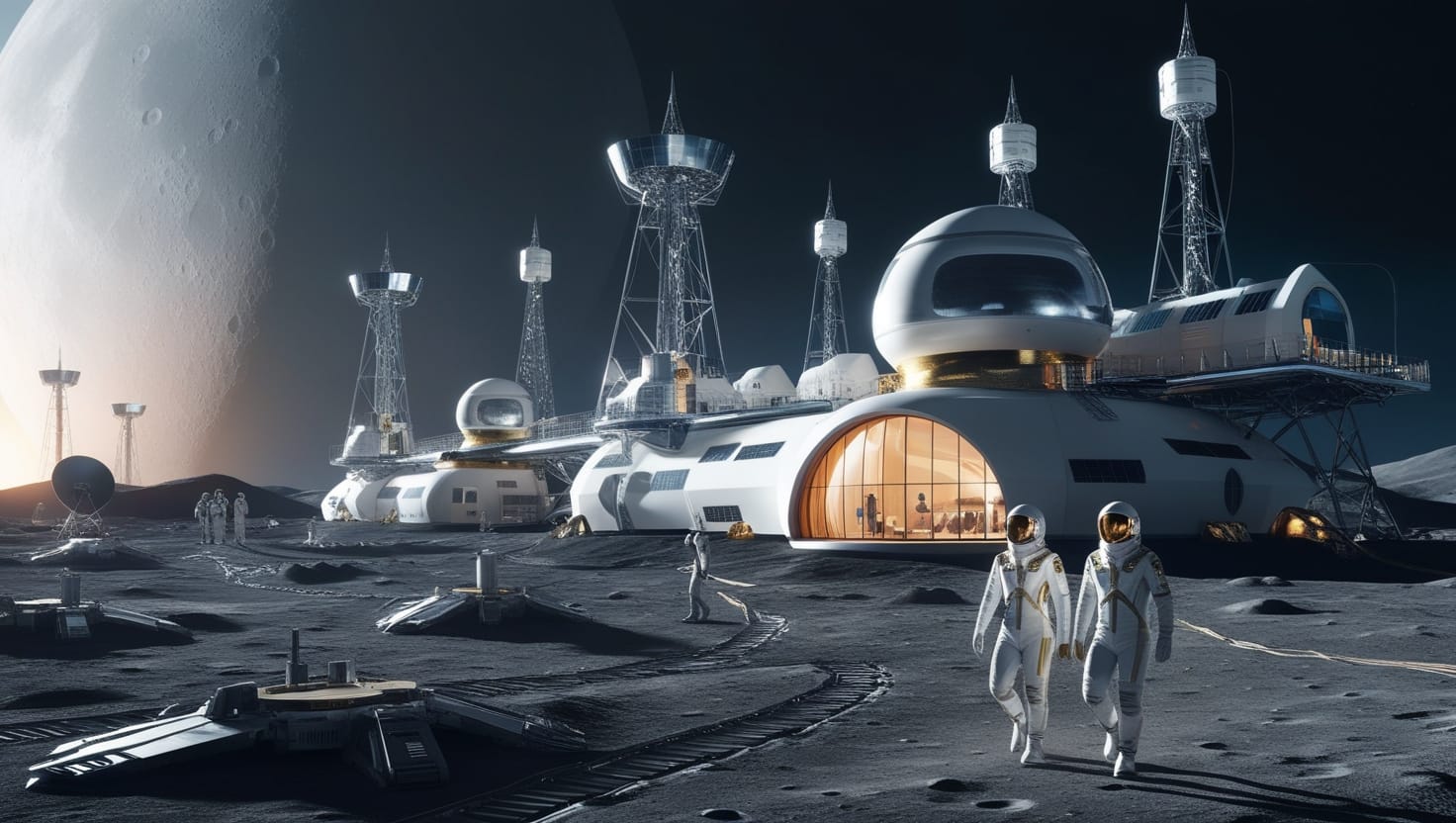
Scientists plan to extract water from lunar ice, turn it into rocket fuel, and use 3D-printed regolith habitats to protect against micrometeorites and temperature extremes.
The Artemis program and commercial missions will test these systems before deploying them on Mars.
💫 Further reading: Asteroids, Mining, and the Next Frontier of Space Resources
The Vision for Mars Colonization
Mars colonization remains the ultimate goal — a bold step toward becoming a multi-planetary species.
But it comes with challenges: a thin atmosphere, harsh radiation, and low gravity.
New advances in AI habitat control, reusable spacecraft, and autonomous construction are paving the way for sustainable living on the Red Planet.
Projects like SpaceX’s Starship, NASA’s Artemis, and ESA’s Mars Sample Return mission all contribute to the technology stack that will make permanent settlement possible.
💫 Also read: Space Telescopes: Unlocking the Secrets of the Universe
A Future Built on Innovation
From the first Moon landing to the next generation of reusable spacecraft, every technological leap brings us closer to establishing humanity’s place beyond Earth.
The evolution of space travel technologies — rockets, propulsion, AI, and sustainable habitats — forms the backbone of our journey to the Moon, Mars, and eventually, the stars.
This topic is part of our complete guide to AI in Space Exploration.